
Amidst a global pandemic last year, businesses across the country began to face a new, unfamiliar challenge. 2021 saw the emergence of a global economic trend recognized as “The Great Resignation”, where employees voluntarily left their jobs en masse. Organizations in COVID-sensitive sectors like leisure and hospitality were hit especially hard. According to research from Business Insider, employees within these industries left their jobs at a rate double to the national average (6.4% vs. national rate of 3.0% in September 2021). More recently, the trend has shifted from employees resigning from their roles to increased demand and expectations for the right roles.
Unsurprisingly, human resources has become a major focus. In GGA Partner’s A Club Leader’s Perspective: Emerging Trends & Challenges survey, 67% of club leaders indicated employee retention being a key financial risk to their club and 77% of clubs see employee recruitment and retention being key issues facing the industry moving forward.
The big question facing those charged with governance is, what can we do to retain employees? The immediate solution is to raise compensation, which was indicated in the Club Leaders Survey as the most successful tactic in retaining employees. Clubs seem to be reacting accordingly, indicating planned raises to payroll by an average of 7.8% across all departments. Although increased wages are an important consideration, there’s more to the story.
McKinsey notes the strong connection between employee satisfaction and relational attributes (feeling valued, relationships with management, potential advancement) compared to more transactional attributes (compensation, prestige, role/company). Today, employees are thinking about what they want out of their job now more than ever.
Returning to the original question, how can organizations prioritize relational attributes to increase employee satisfaction?
Understanding the Problem
Surveys are a powerful tool to assess member feedback and provide a quantitative component to member feedback received on a day-to-day basis. The same attitude should be considered with employee relationships. Although results from a full employee survey will mostly be leveraged at the management level, this information is important for all at the club to understand how satisfied employees are through establishment of both an overall and department specific Employee Net Promoter Score, as well as how retention programs are performing.
Start at the Top
Employee satisfaction and retention are key concerns throughout all areas of the business; however, it is important to ensure those charged with governance do not bridge the gap between governance and management. While the board is directly charged with evaluating the General Manager (often its only direct employee report), it can also support establishing the structure and measurement method for evaluating other key management positions, as well as the structure for a comprehensive 360-degree review program for all employees. Boards should aim to establish a policy requiring a quantitative element of performance evaluation to key management figures within the club. This type of formalized, quantitative performance evaluation structure should be “pushed down” from the top level as an example to use throughout the club. This form of evaluation ensures employees are aware they will be provided the opportunity for advancement as well as providing SMART (Specific, Measurable, Attainable, Relevant and Time-Based) goals. The board can then monitor the club’s performance evaluation structure and process through the GM with a requirement for periodic reports at specified intervals.
Determining Quantitative Goals
In developing this performance evaluation technique, identifying which quantitative goals on which to evaluate an employee is an important determination. If the metric does not meet the SMART criteria, the employee may feel as if they are tasked with an impossible goal and satisfaction (as well as ambition) may decrease. Evaluation criteria should relate to key performance indicators established for the entire club that align with organizational goals. For example, if your club is attempting to grow the membership, raising the Net Promoter Score of the membership measured through an annual survey may be a performance evaluator established for the GM/COO of the club. For clubs at capacity, perhaps overall satisfaction score and/or ‘value for dues’ is a more aligned KPI for performance.
Take the below general example of a quantitative approach to evaluation (every club should determine the categories and weightings based on specific KPIs and goals established for their individual club). This score may be used to determine discretionary compensation, such as performance bonuses, raises or be used for evaluating candidates for internal promotions.
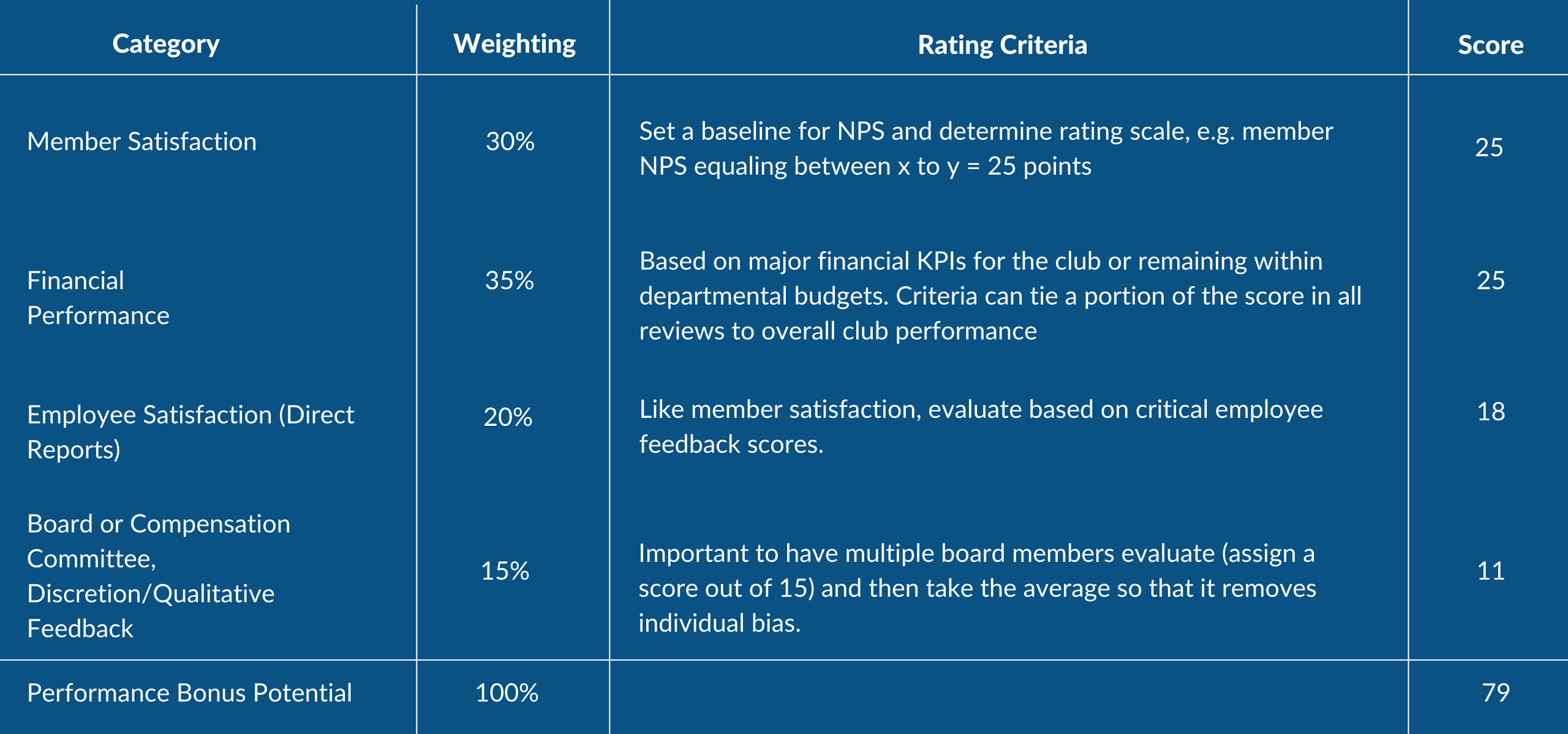
Employee retention is a key area of concern for clubs across the country and the world, and those charged with governance can take steps to help improve employee satisfaction throughout their business. These techniques will assist boards in understanding, setting, and maintaining performance standards that flow through the entire club, creating a transparent workplace with clear paths for goal attainment and advancement.
This article was authored by Ben Hopkinson, Director, Evan Van Eerd, Manager, and Adrian Mazzarolo, Senior Associate for Boardroom Magazine.