
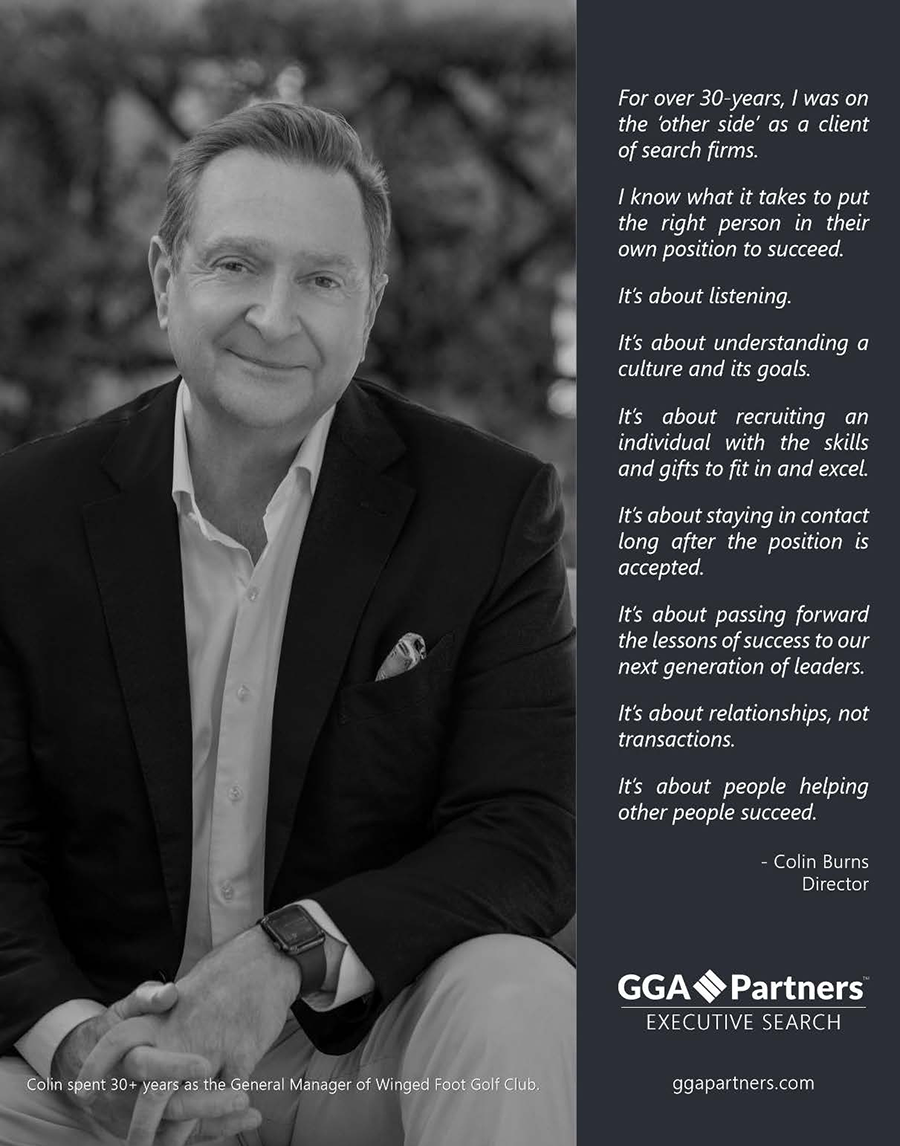
GGA Director Colin Burns, CCM, brings his print ad to life in a new video highlighting his beliefs about the role of an executive search consultant.

GGA Director Colin Burns, CCM, brings his print ad to life in a new video highlighting his beliefs about the role of an executive search consultant.
BLUFFTON, S.C., and LIBERTY CORNER, N.J. (April 14, 2021) – The United States Golf Association (USGA) will join with GGA Partners (GGA), an international consulting firm, to launch a new service to place top-notch golf course superintendent candidates at facilities across North America.
As part of its suite of advisory services, GGA has long provided executive search services for facility clients. The collaboration will expand the company’s offerings, with the USGA Green Section’s agronomic and maintenance expertise serving as key factors in targeting the unique needs of each golf course and identifying superintendents with matching skills who can help facilities elevate playing conditions, improve course presentation and foster sustainable practices.
“For any golf facility, the ability to hire the right talent is crucial for long-term success, and we believe in creating and maintaining partnerships with facilities,” said Patrick DeLozier, GGA’s managing director of executive search. “The stakes are higher than ever for facilities looking to hire superintendents, and they are looking for candidates with a wide variety of skills.”
Added Craig Johnston, a GGA partner: “The ability to complement our services in strategy, facility governance, finance and operations with the USGA’s agronomic strength will ensure that we can continue to support our clients with the gold standard in best practices, education, innovative products and research.”
The collaboration will allow the USGA to expand its reach and enhance its ability to inform best management practices for golf course maintenance, including resource prioritization. As part of its mission to champion and advance the game, the USGA is helping to ensure a sustainable game in which course managers are empowered to create a positive experience for their golfers.
“GGA’s values and business areas are strategically aligned with our mission,” said Matt Pringle, managing director of the USGA Green Section. “With this new joint service, we can find the best match between the needs of the golf course and the skill set of their next superintendent, while providing ongoing support to deliver outstanding playing conditions and improved golfer satisfaction.”
The joint service will utilize the USGA’s nationwide network of agronomists, whose extensive knowledge of the facilities and superintendents in their regions will be pivotal to the program’s success. They will work closely with DeLozier, who heads up the firm’s executive search practice.
To learn more, contact Patrick DeLozier at patrick.delozier@ggapartners.com or Elliott Dowling at edowling@usga.org.
About the USGA
The USGA is a nonprofit organization that celebrates, serves and advances the game of golf. Founded in 1894, we conduct many of golf’s premier professional and amateur championships, including the U.S. Open and U.S. Women’s Open. With The R&A, we govern the sport via global set of playing, equipment, handicapping and amateur status rules. The USGA campus in Liberty Corner, New Jersey, is home to the Associations, Research and Test center, where science and innovation are fueling a healthy and sustainable game for the future. The campus is also home to the USGA Golf Museum, where we honor the game by curating the world’s most comprehensive archive of golf artifacts. To learn more, visit usga.org.
About GGA Partners
GGA Partners™ is an international consulting firm and trusted advisor to many of the world’s most successful golf courses, private clubs, resorts, and residential communities. We are dedicated to helping owners, asset managers, club and community leaders, investors and real estate developers tackle challenges, achieve objectives, and maximize asset performance.
Established in 1992 as the KPMG Golf Industry Practice, our global team of experienced professionals leverage in-depth business intelligence and proprietary global data to deliver impactful strategic solutions and lasting success. GGA Partners has offices in Toronto, Ontario, Phoenix, Arizona, Bluffton, South Carolina, and Dublin, Ireland. For more information, please visit ggapartners.com.
Governance in private clubs can too often resemble what is seen on the evening news: factions, resentment, distrust, skepticism, cynicism. In troubled times, sound governance is essential.
In our continuing Whitepaper Series, Senior Partner Henry DeLozier highlights the three keys to effective governance and proactive steps leaders can take to address and improve it at their club.
At GGA Partners, we have watched the pandemic create innovative opportunities and innovation in clubs unlike what we have seen in many years.
In our continuing Whitepaper Series, Senior Partner Henry DeLozier reminds managers and club leaders how critically important innovation is, especially during these pandemic times.
TORONTO, Ontario – GGA Partners, a global consulting firm, has released In Pursuit of Innovation, the fourth in its series of thought leadership whitepapers. This authoritative guide explores how surviving in today’s competitive landscape depends on the ability of clubs and organizations to unlock their creative potential and offers up several guidelines to allow freedom of thought and imagination.
In Pursuit of Innovation highlights the way companies must continuously transform in order to survive and how a constant pursuit of innovation will guard against failure, whether gradual or sudden. The paper clarifies exactly what constitutes innovation, where it comes from, and how club leaders can practice innovative thinking to unlock a culture of creativity.
“Our experience with thousands of private clubs over nearly three decades shows us that without innovation clubs become stale, membership falls until it eventually flatlines, competitive advantages diminish, members become dissatisfied, and talented staff look elsewhere,” explained GGA Partner Henry DeLozier, one of several authors of the piece. “Innovation can come from anywhere inside an organization, and we think it should be encouraged from all corners, from the folks raking bunkers to the person answering phones to the accountant balancing the books.”
Innovation happens at the intersection of problems, opportunities, and fervent minds but must be deliberately sought, practiced, and encouraged at all levels. “It’s normal in any business to want to maintain the status quo. It’s comfortable, it’s safe, and it’s easier than making changes,” said DeLozier. “In reality, the status quo only works for so long. If you’re going to grow, you must innovate.”
In Pursuit of Innovation illuminates four common roadblocks to an innovative culture and identifies the steps necessary to unlock a culture of creativity.
In addition to innovation, GGA Partners has published new whitepapers on strategic planning, branding, and governance which are accessible via the firm’s website.
About GGA Partners
GGA Partners™ is an international consulting firm and trusted advisor to many of the world’s most successful golf courses, private clubs, resorts, and residential communities. We are dedicated to helping owners, asset managers, club and community leaders, investors and real estate developers tackle challenges, achieve objectives, and maximize asset performance.
Established in 1992 as the KPMG Golf Industry Practice, our global team of experienced professionals leverage in-depth business intelligence and proprietary global data to deliver impactful strategic solutions and lasting success. For more information, please visit ggapartners.com.
Media Contact:
Bennett DeLozier
GGA Partners
602-614-2100
bennett.delozier@ggapartners.com
The Club Management Association of America (CMAA) is the leading professional association for managers of membership clubs. With nearly 6,800 members across all classifications, CMAA manager members run more than 2,500 country, golf, city, athletic, faculty, yacht, town and military clubs. The objectives of CMAA are to promote and advance friendly relations among persons connected with club management; to encourage the education and advancement of its members; and to assist club officers and members, through their managers, to secure the utmost in efficient and successful operations.
CMAA’s research efforts have grown exponentially over the past several years, increasing the depth and breadth of information available to CMAA members and the broader club industry. In the Summer of 2020, CMAA released its updated competencies for the club management profession which featured the addition of data analytics as a core competency. Today “the numbers” are more important than ever and understanding what they mean, identifying trends, and deploying them for informed management decision-making is no easy task.
As a long-time CMAA Business Partner, GGA Partners has been called upon to assist members of the Association in exploring the recently released 2020 Finance and Operations Report – a detailed report of key financial and operating data from the club management industry which is based upon confidential surveys completed by 357 clubs in 2020 and includes a compilation and analysis of club finance and operations data.
In January 2021, CMAA launched a new micro-podcast series to help to bring the numbers to life, make them understandable, and give them context. In each of installment of the five-part series, Derek Johnston, CIA (Partner, GGA Partners) and Phil Newman, CPA, CIA (Partner, RSM) feature as expert resources to elucidate the significance of the research findings, expound the implications on club management, and translate the best practice application of these insights to club operations.
Johnston and Newman sat down with CMAA’s Melissa Low, CAE (Senior Director, Communications and Government Relations) and Kyle Jennings (Manager, Communications) to conduct the first in the series, a full-length podcast to introduce the series and provide an overview of club finance and operations.
Listen to the first podcast, below, for an overview of the series and dive deeper into the research in future episodes which will become available here and on the CMAA Soundcloud page. Subsequent episodes feature shorter “micro-pods”, 15-minute episodes focused on one of four key areas highlighted by CMAA in their Executive Summary.
Full-length podcast, 45 minutes
Using a methodical approach, the series begins with a high-level discussion about the Executive Summary of the report, the value of the research findings, and possible ways managers can use the financial and operational data in their roles.
Micro-podcast, 16 minutes
“Take a look at your audited financial statements. What’s the first page? It’s the balance sheet…This is the most important financial statement,” explained Phil Newman. Listen to the second episode in the series to find out why understanding capital is so important in club management.
Micro-podcast, 11 minutes
It has been said that golf facilities have been one of the unintended and lucky beneficiaries of situational and environmental changes brought on the coronavirus pandemic. But what does it mean for club operations and what changes should be expected in the new normal? Tune into the third episode in the series to find out.
Micro-podcast, 14 minutes
The fourth installment in the series hones in on that which all clubs have – members. That is, until they don’t. Hear from the experts on membership attrition and why membership numbers are such a key driver on financial outcomes for club businesses.
Micro-podcast, 26 minutes
The last installment in the series dives into the Personnel section, exploring how the interrelated components of dues, operations, and membership impact personnel considerations, staffing philosophy, and levels of service. “It’s really important to make sure you’re tracking all the different lenses through which you can look at your labor force,” said Derek Johnston. Listen in for more insights.
We want to hear from you, get in touch with us for additional information on how best to look at your club’s financial and operational performance data:
Connect with Derek Johnston (Partner, GGA Partners) on LinkedIn
Connect with Phil Newman (Partner, RSM) on LinkedIn
TORONTO, Ontario – International consulting firm GGA Partners has released Leveraging Differences in the Boardroom, the third in its new series of thought leadership whitepapers. This authoritative guide explores the benefits of clubs with diverse boards and suggests several steps to take when recruiting with diversity in mind.
Leveraging Differences in the Boardroom evaluates the consequences of unintentionally insular board composition and challenges the idea of “sameness” in the boardroom, which limits the ability of a board to effectively perform its duties and threatens a club’s health and longevity. The paper illustrates how multiple perspectives contribute to greater success in governance and argues for adjusting the profile of a club’s leadership to better serve members and prospects.
“We often see board members with similar professional, cultural, and ideological backgrounds and perspectives,” explained GGA Partner Henry DeLozier, one of several authors of the piece. “Boards that are neither representative of the membership nor reflective of their surrounding community risk losing the opportunity both to serve their current members and to attract new members.”
In addition, the whitepaper encourages that clubs intent on increasing diversity among their board take a holistic, multi-dimensional approach to its creation. “Forward-thinking boards understand that it is the breadth of perspective, not the mere inclusion of various diverse traits, that benefits the organization,” said DeLozier. “In addition to social diversity, professional and experiential diversity are also important in increasing the range of perspectives represented on the board.”
Board diversification is likely to be met with resistance from the status quo, which the paper aims to help club leaders overcome by providing tactics for building a diverse board, developing new board member criteria, and making a commitment to diversity.
In addition to governance, GGA Partners recently published new whitepapers on strategic planning and branding. The firm has announced that another in the series focused on innovation will be published through the third quarter of 2020.
About GGA Partners
GGA Partners™ is an international consulting firm and trusted advisor to many of the world’s most successful golf courses, private clubs, resorts, and residential communities. We are dedicated to helping owners, asset managers, club and community leaders, investors and real estate developers tackle challenges, achieve objectives, and maximize asset performance.
Established in 1992 as the KPMG Golf Industry Practice, our global team of experienced professionals leverage in-depth business intelligence and proprietary global data to deliver impactful strategic solutions and lasting success. For more information, please visit ggapartners.com.
Media Contact:
Bennett DeLozier
GGA Partners
602-614-2100
bennett.delozier@ggapartners.com
GGA Insights exists to support you as a club leader, offering you solutions, tools, and tactics today that can help you improve your work life tomorrow. But putting change into practice can be a challenging endeavor. GGA Director, George Pinches, offers a road map for translating genuine insights and data into meaningful boardroom action.
Most private clubs are like cruise ships; they do change direction, but very slowly. They are often steeped in tradition, and while this is a powerful asset, it can also hold clubs back.
In reality, clubs need agility if they are to respond and adapt to the fast-evolving demands of changing markets, new technology and generations of new members.
But don’t lose hope; with more data available to us than ever, there is reason for optimism.
Data can clarify the changes that need to be made, shape the direction of travel, and safeguard clubs from the obstacles and pitfalls they may otherwise run into.
But the truth is, before data can be put into such effective practice, many clubs and boards require a cultural shift to recognize the value of it.
Commitment first
When my GGA colleague, Fred Laughlin, first introduced the Club Governance Model, he stressed the importance of obtaining a board commitment before undertaking transition.
This is because research demonstrates it usually takes three administrations for significant changes to be fully adopted by a club board.
In order to move away from what we typically see – decisions based on anecdotal evidence rather than genuine insights and hard facts – this is the process to follow: commitment first, then change follows.
For you, obtaining commitment from your board and committees means convincing them that the use of data-driven decision making is mutually beneficial.
Once your board members start asking “What are the facts? Do you have comparable data or industry benchmarks to support this recommendation?”, then your club will be on track to a brighter future based on genuine insights.
Shifting the dial
It’s clear that clubs can no longer rely on decisions based on institutional memory and personal opinion. But how do you (in practical terms) achieve such long-lasting change?
When it comes to shifting the culture, timing is key.
One of the best opportunities to start a culture shift is at the beginning of a new tenure. This tends to be a ‘honeymoon period’ for the new GM or COO, when support and expectations are running high.
Take the opportunity to assess the culture and seek ways to introduce change: commitment first, change to follow. If your board has an annual board retreat, this can be an opportune time to take action.
Beyond that, I’d recommend focusing on these three key areas to encourage a sustainable culture shift towards a data-driven future:
Finding ‘your’ way
Process and structure will help, but a true shift in culture can only be achieved through intelligent and thoughtful execution. In some cases, this means finding the unique tactics which work best for you and your Board.
‘Shifting culture’ will not appear in many job descriptions of club leaders. But, for a lot of clubs it should be at the very top. It holds the key to disrupting what can be a perennial cycle of decisions based on what those in power ‘think’ is right.
My advice: think long-term (beyond 5 years), actively gain the buy-in and commitment of board members, and put a structure and process in place to ensure data and intelligence are at the heart of how your Club operates.
Phone calls, emails, knocks on the door… all contribute to those days when you feel busy, but achieve nothing. GGA’s Patrick DeLozier outlines some tactics aimed at eliminating those fruitlessly busy days from your calendar.
There’s nothing more frustrating than a hollow sense of fulfillment at the end of a tiring day. Fulfilling in that you’ve been busy and active, hollow in that you’re no nearer to completing any of the tasks you set out to.
The first thing to make clear is, it’s a common problem. It affects us all. And while some of these days are inevitable, throughout my 18 years in the private club industry I made a conscious effort to develop methods of mitigating their impact and focusing on productive outputs.
Winning the day
It all starts before you even set foot in the workplace.
Develop a routine that gets your mind organized and focused from the get-go. For me, it was a morning swim, followed by reading several newspapers and social media news briefs that helped put me in an optimal productive state. So whether it’s a workout, meditation, yoga, or simply a coffee, find what works for you and stick to it.
When it comes to the working day itself, I found it particularly helpful to break this into three stages:
For the up-brief, tasks should be specific, achievable, and aligned towards set objectives, prioritizing what you need to achieve and by when. Try to avoid tasks which veer away from your objectives or can be easily completed by another member of your team. Delegating tasks can often test your sense of trust and judgement in other team members, but is critical when it comes to staying focused on what’s important (and befitting of the Club Manager role).
During the day, make time to measure where things stand. If a task due for completion is in doubt, can you call in additional resource? If team members have become distracted by inane endeavors, is there time to pull them back and refocus their attention where it should be?
Finally, don’t allow the day to go by without assessing what has been accomplished during a debrief session. This is your opportunity to not only review your own achievements, but reward team members for a job well done and completed on time. They should also understand how this has helped (or is helping) towards the overarching objectives of the Club, as this will encourage their buy-in to the bigger picture.
Conversely, you will also need to confront incomplete tasks or missed deadlines. This is where balance and accountability come in, as you need to address these without demotivating your team.
Though some may find these stages overbearing, consistent monitoring and clear communication will allow team members to stay on task and focused for success. Ultimately, accountability will combat procrastination and instill a goal-oriented culture at your club.
Working smart
Aside from external distractions, what can you do as a manager to work smarter? Here’s what I learned from nearly two decades at the sharp end of club management:
There are so many simple ideas out there that can help you overcome distractions, and they can be very effective. But if you can isolate a structure which is focused, holds everyone to account, and is married to your club mission, you can unlock something greater: a productive culture. A culture driven by goals, achievement and success. And that is something that no one wants to get in the way of.
TORONTO, Ontario – GGA, the leading authority on successful ownership and management practices for golf, private club, resort, and residential real estate businesses, has named Michael Gregory and Craig Johnston partners of the firm.
 Gregory joined GGA in 2007 following a successful college career during which he was an All-American scholar earning a business degree and captain of the golf team. Since joining the firm, he has helped more than 400 clubs develop and implement a game plan for success. In addition to his client relationships, Michael has managed the firm’s internal workflow team of business analysts and market researchers for the past five years.
Gregory serves as a lead strategist for successful private club business and membership solutions at GGA and is renowned for his ability to use comprehensive membership and market intelligence to develop actionable strategic solutions for clients.
 Johnston is a Chartered Professional Accountant (CPA, CA) and alumnus of KPMG. Prior to joining GGA, as a ranked equity research analyst for Scotia Capital, he was recognized in 2016 by Thomson Reuters as the #1 earnings estimator in his sector.
Johnston supports GGA clients in the development and implementation of goal-oriented business strategies to achieve targeted operating and investment objectives. He is a seasoned business strategist and investment executive who leads GGA’s transaction advisory practice, having successfully advised on some of the largest transactions in the club industry over the past three years.
“Craig and Michael have distinguished themselves as expert, reliable confidants to our clients and deliver value day-in and day-out,” commented GGA Senior Partner Henry DeLozier. “The firm will benefit from their joining the senior leadership ranks.”
“Both Michael and Craig have become clear leaders in our firm and mentors to our team of consultants,” said Founding Partner Stephen Johnston. “Their work ethic and dedication to excellence in professional services is an incredible asset to our firm.”
About GGA
GGA has provided industry-leading advisory services to more than 3,000 clients worldwide including private clubs, hotels, resorts, residential golf communities, developers, homebuilders, government agencies and municipalities, financial institutions, investors and lenders. Operating out of three global offices in Toronto, Phoenix, and Dublin, GGA is a highly specialized consulting firm focused on club and leisure related assets with a professional services heritage as the KPMG Golf Industry Practice. The firm’s expertise lies in its ability to effectively meld club management and operational expertise with highly capable professional strategists and experienced business analysts. GGA personnel include former club managers with experience leading exceptional clubs, along with alumni of Deloitte, Fairmont, KPMG, Marriott, Pulte Homes, PwC, and Scotia Capital. For more information, please visit www.globalgolfadvisors.com.
Media Contact
Derek Johnston, Partner at GGA
djohnston@globalgolfadvisors.com
905-726-0701